Secrets
A secret in the catalog is a name. Its value comes from the server's environment, or from a value an admin stored in the Config studio, encrypted under a master key that is never in the database. An environment variable always wins.
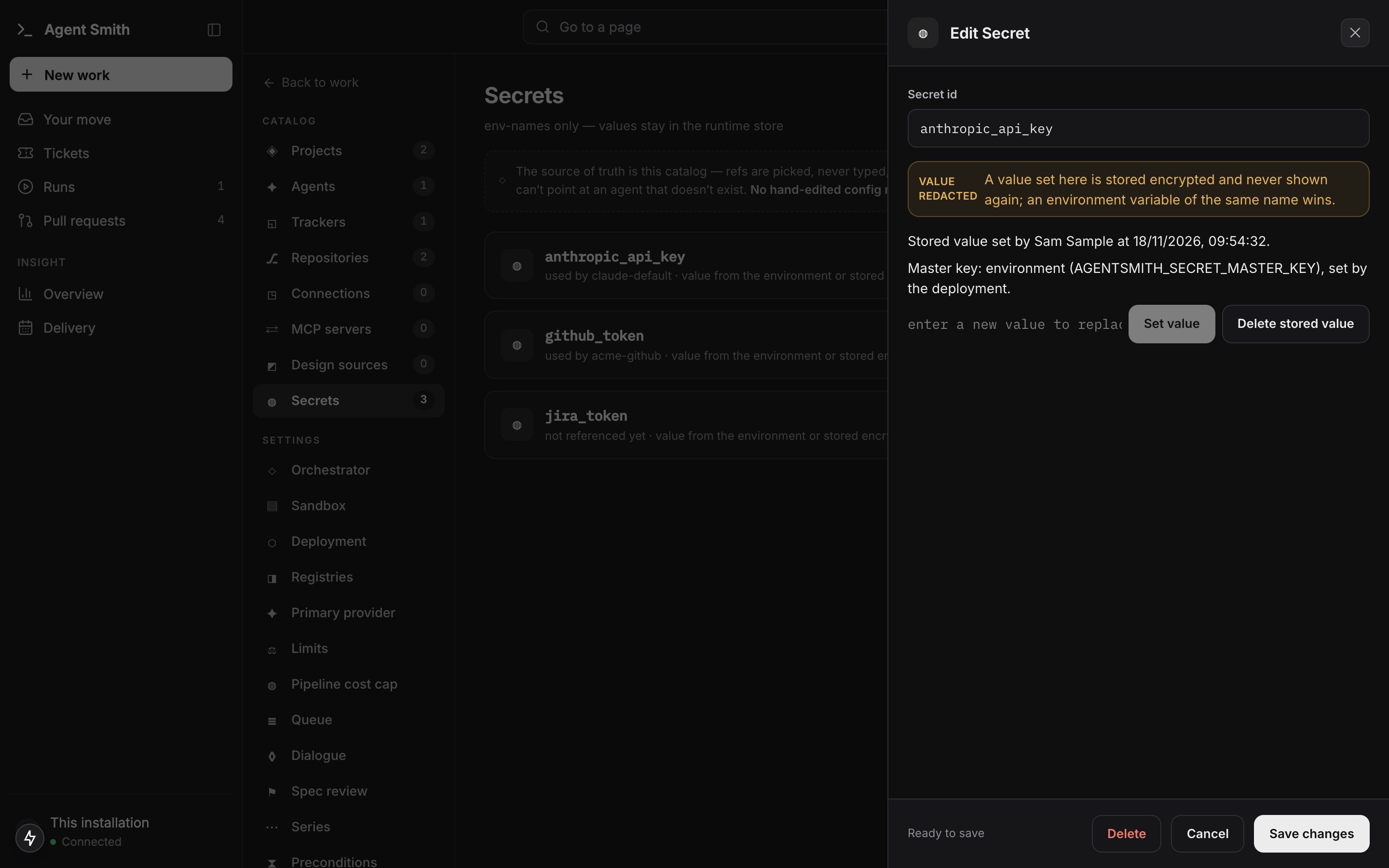
What the catalog holds
The Secrets catalog holds each secret's name, the environment variable it reads, and what references it. Trackers, repositories, connections, agents and design sources pick their secret from this list, so a reference can't point at a secret that doesn't exist. A secret something still references can't be deleted. Values never appear in an export.
Where a value comes from
For every credential the server needs, the same order applies:
- The environment variable, when it is set and not empty.
- The stored value of the catalog secret of that name, set in the studio.
So a deployment that already passes every token as an environment variable keeps working unchanged, and an installation without access to its runtime environment can set values in the studio instead. The rule covers tracker and repository tokens, agent keys, the webhook secrets (GITHUB_WEBHOOK_SECRET, GITLAB_WEBHOOK_TOKEN, AZDO_WEBHOOK_SECRET) and the Slack and Teams credentials (SLACK_BOT_TOKEN, SLACK_SIGNING_SECRET, TEAMS_APP_PASSWORD). Those are read on each use, so a stored value reaches them without a restart.
What stays environment-only is what the server needs before it can open the database: the persistence settings, the master key itself, and the sign-in settings.
Which variable a secret reads
A secret you create in the studio reads the environment variable of exactly its name, case included: a secret GITHUB_TOKEN reads GITHUB_TOKEN, and a secret github_token reads a variable called github_token. So name it after the variable. A secret that came in through Import agentsmith.yml keeps the reference its file gave it, so github_token: ${GITHUB_TOKEN} reads GITHUB_TOKEN. An entry of the same name in the secrets: block of the server's own agentsmith.yml wins over both, on every load (what a server reads from the file).
An agent's key secret is looked up by name, ignoring case: the agent reads the environment variable its api_key_secret spells, and if that is empty, the catalog secret of that name with its stored value. api_key_secret: ANTHROPIC_API_KEY finds a secret named anthropic_api_key. The fallback variables per provider are on AI providers.
Storing a value
Open the secret, type the value into the password field and press Set value. Setting a value needs secrets.write. The value goes straight to the server and is written by a secret run with a run id, so the change is attributed like any other.
Each value is encrypted with a key of its own (AES-256-GCM with a random nonce, so two equal values never store equal bytes), and that key is wrapped by the master key. The master key is never in the database. Without one the field says so and stores nothing.
A stored value is never shown again: not by the studio, the API or the admin assistant. The drawer shows who set it and when, and Delete stored value removes it. Setting it again rotates it.
The master key
Give the server 32 random bytes, base64-encoded, in one of two ways:
| Variable | What it holds |
|---|---|
AGENTSMITH_SECRET_MASTER_KEY |
the base64 key itself |
AGENTSMITH_SECRET_MASTER_KEY_FILE |
a path to a file holding it, for a mounted k8s Secret |
In docker-compose, put it in the .env file the server reads. On Kubernetes, add it to the server's Secret.
Keep the master key
The master key is the only way to open the stored values. Lose it and every stored value reads as empty: back it up the way you back up the database.
Rotating the master key
Move the old key to AGENTSMITH_SECRET_MASTER_KEY_PREVIOUS (or AGENTSMITH_SECRET_MASTER_KEY_PREVIOUS_FILE), set the new one, restart, and press Re-wrap with the current master key in any secret drawer. Every stored value is then wrapped with the new key and the previous one can go. Identical current and previous keys are refused.
When a value can't be opened
A stored value the server can't open (the master key that wrapped it is gone, the vault can't be reached, or the row was altered) resolves to nothing and is reported on every load, naming the secret and its key. For the webhook secrets and SLACK_SIGNING_SECRET that state refuses every delivery, and each refusal is logged with the secret and the reason, until the value is set again or the environment variable is. A secret with no value at all, in the environment or stored, leaves verification off, as before.
Orphaned values
A stored value whose catalog secret was deleted is listed in every secret drawer, with who set it and when, and a Delete. The admin assistant can draft the same cleanup. Applying that draft needs secrets.write besides admin.assistant; without it Apply is refused and names the permission.
Keeping the master key in Azure Key Vault
The deployment can hold the master key wrapped instead of raw, so a leaked environment or k8s Secret is useless without access to the vault. Create an RSA key (2048 bits or more) in Key Vault, give the server's identity the Key Vault Crypto Service Encryption User role on it, and wrap a fresh 32-byte key with the key's public half:
az keyvault key download --vault-name <vault> --name <key> --file key.pub.pem
openssl rand 32 | openssl pkeyutl -encrypt -pubin -inkey key.pub.pem \
  -pkeyopt rsa_padding_mode:oaep -pkeyopt rsa_oaep_md:sha256 -pkeyopt rsa_mgf1_md:sha256 | base64
Set the output as AGENTSMITH_SECRET_MASTER_KEY_WRAPPED (or mount it and point AGENTSMITH_SECRET_MASTER_KEY_WRAPPED_FILE at it), and set AGENTSMITH_SECRET_KEY_VAULT_KEY to the key's versioned identifier, https://<vault>.vault.azure.net/keys/<key>/<version>. The server asks the vault to unwrap the key once, when it first needs it. It signs in as itself: workload identity, a managed identity (AZURE_CLIENT_ID picks a user-assigned one) or a service principal from the environment, never someone's az login. If the vault doesn't answer, stored values read as empty and the drawer says why.
To move an existing raw key into the vault, wrap that same key (echo <base64 key> | base64 -d | openssl pkeyutl …) and swap the variable. Stored values keep opening without a re-wrap. For a new key, keep the old one as AGENTSMITH_SECRET_MASTER_KEY_PREVIOUS or AGENTSMITH_SECRET_MASTER_KEY_WRAPPED_PREVIOUS and press Re-wrap. A previous wrapped key is unwrapped with AGENTSMITH_SECRET_KEY_VAULT_KEY_PREVIOUS, or with the current vault key when that variable is unset.
The key's source is part of the deployment and not a setting, because anyone who can write the database could otherwise point it at a key they hold. The secret drawer shows which source is in use.
Next
- The Config studio: the rest of the catalog.
- Admin assistant: reads secret presence, never values.
- Access control: who holds
secrets.readandsecrets.write.